

She asks you not to hold her. Let her alone tap on the water, splashing, climbing, giggling. While other times she’s run into the swimming pool and tried to jump in! Ah! This makes heart-racing!
Sound familiar? You’re not alone. Toddlers are naturally drawn to water.

Excerpt from Today’s Parent. Pamela Taylor, “Why Water Play Builds Confidence”, 2023.
These are common parent challenges we listened to before they’ve met Sauf Vest – a PFD loved by the kids
The fearless
- My 2-year-old daughter loves to turn her head around in the pool. This makes her swallow water and cough. I knew she was experimenting. But this makes me worry.
- My 18-month-old son does not like to use the swim ring. He complains his arm is tired and wants to feel like swimming in the water, not on-the-water. So now I have to hold him whenever we go to the pool.
- Why does my 1-year-old son love to put his head back in the water like he’s lying? Why is he doing that?
- I geared my 2-year-old with an arm band. He keeps removing it. Then I bought him a swim jacket. The jacket rides up to his face, and it is super easy for him to remove.
When to start using the right float
Is your toddler making those stunts? If yes, the answer is now!
Those are signs your young kids have a high interest in the water, and you should never let your anxiety stop your child’s exploration and development.

Excerpt from the study “Supporting Infants’ Motor Development through Water Activities” (Jakobowicz & Ogonowska-Slodownik, 2024). Motor skills of infants aged 3–12 months improved after water activity participation.
Making pool time stress-free
To help ensure a more enjoyable and stress-free experience for both you and your toddler, it is beneficial to introduce water activities gradually. Even before enrolling your child in formal swimming lessons. You can adopt several practical strategies. These approaches, regularly used by parents of Sauf Vest users, are easily applicable during visits to the swimming pool, beach, or water park!
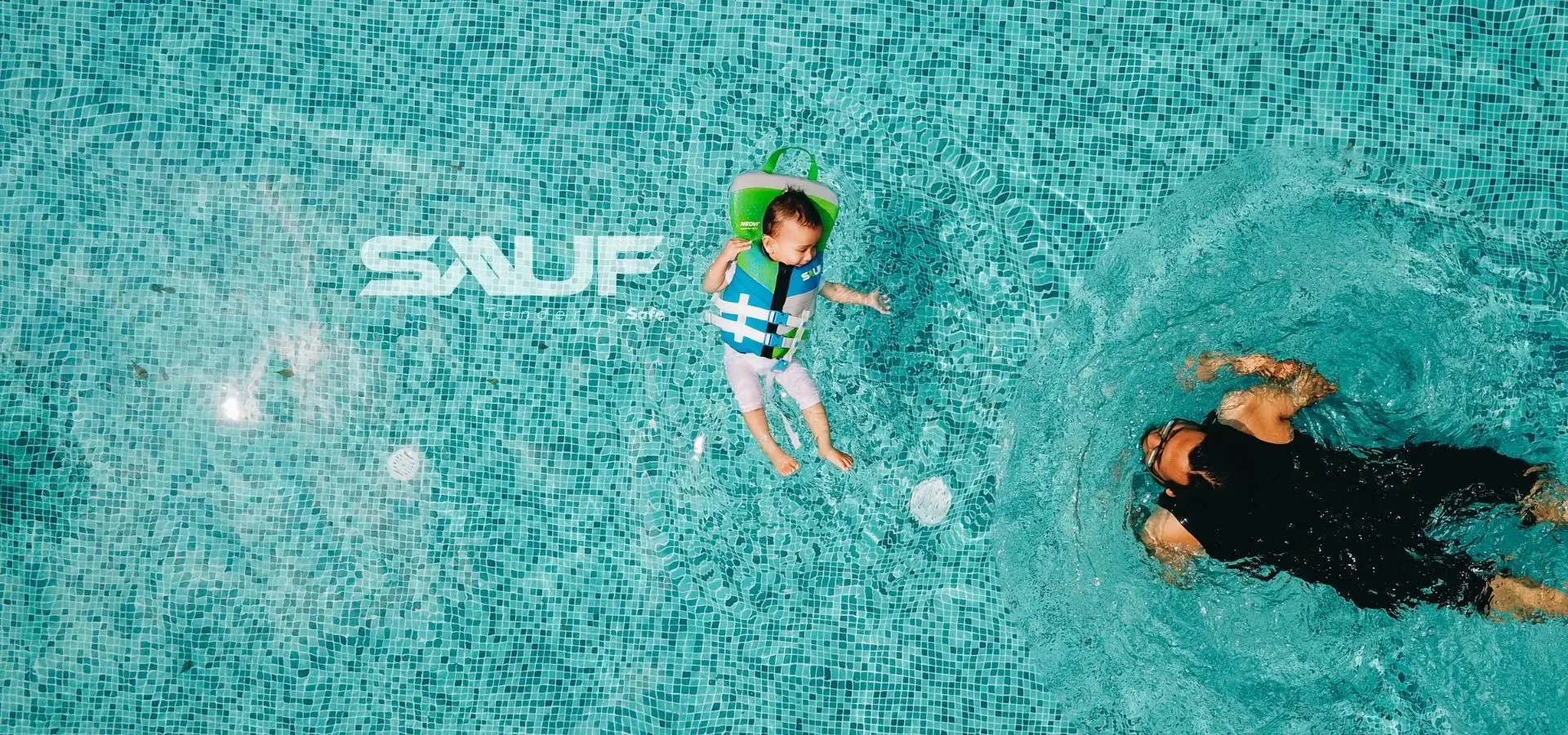
Guide them to float on their backs, calmly.
This is the safest and most relaxed floating position. Also, the fundamental of being comfortable in the water. In the water, panic equals disaster. But then, why is it important for a toddler to learn back floating?
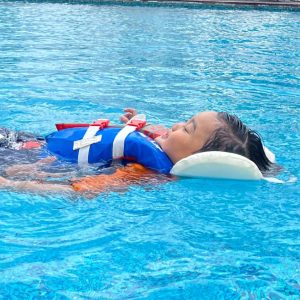
Toddlers who know how to do back floating in calmness have been proven to learn faster in swimming lessons. Calmness is equal to comfort. When doing a float on the back assisted by a Sauf swimming life vest, toddlers get a real sense of floating by:
- Water entering kids’ ears at a minimum (the Large 3-Petals™ feature controls this)
- Facing the wide sky
- Is not at usual body position
Those situations make toddlers panic, struggle and loudly cry in the early few attempts. It is normal for them to react that way. That is why parental assistance is highly needed at this early stage and should not stop encouraging toddlers positively.
This video guide from the Sauf Vest’s parent shares his step-by-step on how he introduces his 3-year-old son to back floating with the Sauf swimming life vest. You can do it yourself at home at you and your toddler’s convenience.
The right floating gear is hardly removable.
Suddenly, the floating gear is here, but the toddlers are somewhere else. Sounds familiar?
When it comes to kids’ safety in the water, the kids’ safety gear must not be easy to remove, dismantle or unbuckle by them. If the kids themselves can unbuckle their flotation gear, what will happen when the forces of the wave!

Easy to remove or unbuckle is closely related to the construction of the kids’ PFDs themselves. The fabric material, inside foam, buckles, and even stitching must have met Coast Guard Approval standards.
Sauf vests are equipped with a double-click lock buckle, making it hard for young kids to un-wear it. Parents’ help is required to unbuckle whenever toddlers want to remove his Sauf swimming life vest.
Floating aid is toddlers’ best friend, not enemy.
Toddlers are known as the most fussy and hard-to-please creatures. Not only about swimming time, but it is also about his wardrobe, sleep area, shoes, even meals. We knew how it turns out when toddler satisfaction isn’t met. Huh!
At this phase, toddlers should be equipped with a flotation aid that does not restricting explorative movements. Climbing, crawling, running, jumping, and sudden fall – all these have been cared for by Sauf swimming life vests. The Sauf’s patented vest design makes toddlers’ movement easier yet not restricted.
The Sauf swimming life vest comes with the Large 3-Petals™ head support, with the role to support toddlers ‘ backs when backfloating in the water. But may also protect the toddler’s head when they fall.
The bottom line
Parents’ anxiety is normal, let alone when involved with a water environment. Even attentive parents can’t react in seconds. The goal is not to fear water – but to have a confident, comfortable yet safe water experience for both parents and toddlers.
It is our responsibility to equip them with well-fitted Coast Guard Approved Kid’s FPDs. Check out this parent’s guide on how and why to choose the right water safety gear for kids.

———————————————————————————————————————————————–
References:
- Today’s Parent. (n.d.). What toddlers learn from water play. https://www.todaysparent.com/family/activities/what-toddlers-learn-from-water-play/
- Supporting Infants’ Motor Development through Water Activities: A Preliminary Case–Control Study. Healthcare (Basel), 2024. Available at: https://www.ncbi.nlm.nih.gov/pmc/articles/PMC11353617/